
Back to standard tunerD TUNING · A4 D4 F♯4 B4

Free D Tuning Ukulele Tuner

Use this free D tuning ukulele tuner to tune a soprano or concert ukulele to A4, D4, F♯4 and B4—a whole step above standard GCEA. Start the microphone for automatic pitch guidance, or play the built-in reference tones and tune by ear. Audio is analyzed privately in your browser and is never uploaded.

01

How to Tune a Ukulele to D Tuning

1. Select D Tuning ADF♯B

D tuning raises every string of standard GCEA by a whole step. From the fourth string nearest your face to the first string nearest the floor, the notes are A4, D4, F♯4 and B4. Before you begin, make sure the tuner is set to D Tuning ADF♯B—Standard GCEA and Low-G modes listen for lower target notes and will show every string as flat.

Choose Guided mode if you are new to tuning or if a string is far from its target. Guided mode lets you select the string you intend to tune, which helps the detector ignore nearby notes and overtones. Auto detect is convenient once the instrument is already close to pitch.
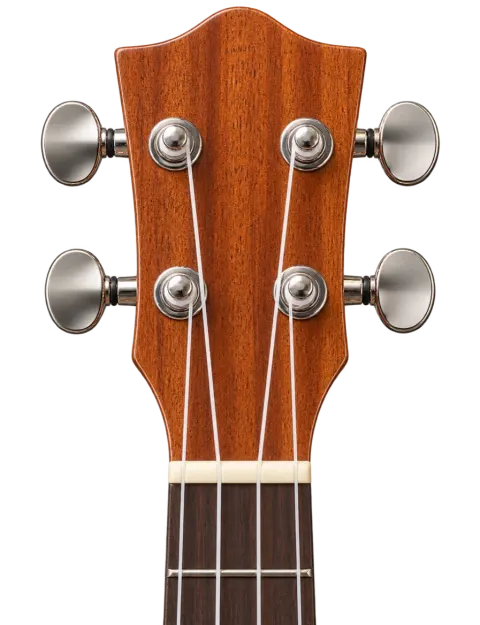
2. Tune the fourth string to A4

Press Start microphone and allow access when the browser asks. Pluck the fourth string gently and let it ring. The target is A4 at 440.00 Hz—the same pitch as the first string in standard GCEA tuning. If the tuner says the note is flat, tighten the string in a small movement. If it says the note is sharp, loosen it, pluck again and watch the stable part of the reading.

Because D tuning is a whole step above standard, the strings will feel slightly tighter than they do in GCEA. That extra tension is normal on a healthy modern ukulele. If a string feels unusually tight long before it reaches the target note, stop and confirm the selected tuning and octave before adding more tension.

3. Tune D4, F♯4 and B4

After A4, tune the third string to D4 at approximately 293.66 Hz, the second string to F♯4 at approximately 369.99 Hz and the first string to B4 at approximately 493.88 Hz. Each note is exactly a whole step above the corresponding string in standard GCEA tuning.

Mute the other strings with your hand while checking each target note. Sympathetic vibration can make a microphone tuner display a neighboring string or an overtone. A soft, even pluck normally produces a clearer reading than a hard attack, especially on the high B string.

4. Check all four strings again

Repeat the sequence from A4 through B4 after the first pass. Changing the tension of one string can slightly affect the others, especially after fitting a new string set. Play a few familiar chord shapes and listen—they will sound a whole step higher than they do in standard tuning, which is exactly what D tuning is meant to do.

New strings stretch during their first few practice sessions, so frequent retuning is normal. Tune upward toward the target in small steps and avoid large peg movements. Once the strings have settled, the instrument should hold pitch for longer between checks.

02

D Tuning Ukulele Notes and Frequencies

String positionTarget noteFrequencyFunction
4th, nearest your faceA4440.00 HzSame pitch as the first string in standard GCEA
3rdD4293.66 HzA whole step above standard C4
2ndF♯4369.99 HzA whole step above standard E4
1st, nearest the floorB4493.88 HzHighest open string

Every D tuning note is a whole step above the corresponding string in standard GCEA tuning. Like standard tuning, D tuning is re-entrant: the fourth string, A4, sounds higher than the third and second strings, preserving the bright, compact character of traditional ukulele voicings.

03

What Makes D Tuning Different?

D tuning raises each open string of standard GCEA by a whole step: G becomes A, C becomes D, E becomes F♯ and A becomes B. The higher pitches increase string tension slightly, which gives the instrument a brighter attack, more volume and a tighter feel under the fingers.

This tuning was the standard for soprano ukuleles in the early twentieth century and is still loved for traditional playing. Because the relative pattern between the strings is unchanged, every chord shape you already know works immediately—each shape simply sounds a whole step higher than it does in standard tuning.

D tuning is a different thing from baritone DGBE tuning despite the similar name. D tuning uses A4, D4, F♯4 and B4 on soprano-family instruments, while baritone tuning uses D3, G3, B3 and E4 on a larger instrument with its own string set.

Most modern soprano and concert ukuleles accept D tuning without any modification. On a delicate, vintage or very lightly built instrument, the extra tension deserves a second thought—confirm with the maker or choose a lighter string set before tuning up.

04

Tips for Accurate D Tuning

  • Remember the sequence as A–D–F♯–B. If the tuner in Standard GCEA mode shows every string as roughly equally flat, the instrument may actually be in D tuning—or the wrong mode may be selected.
  • Tune in a quiet room and move away from fans, televisions and conversations. Background sound makes it harder for the microphone to isolate the fundamental pitch.
  • Use guided mode when the instrument is far out of tune. Selecting A4, D4, F♯4 or B4 tells the tuner which string you intend to adjust and reduces confusion between nearby notes.
  • Pluck one string with a moderate, consistent motion. Very hard attacks create strong overtones and can briefly raise the detected pitch. Watch the reading after the initial attack settles.
  • Mute the other three strings. A ukulele body transfers vibration easily, so an open string may ring even when you did not play it directly.
  • Turn the tuning peg in small increments and approach the final pitch from below. If a string is sharp, loosen it slightly past the target and then tighten it back into tune.
  • Check the tuning again after playing a few chords. New strings stretch, while small tension changes across the bridge and neck can move another string slightly out of tune.
05

D Tuning Ukulele Tuner Troubleshooting

Every string reads as flat in Standard mode

Check which tuning is selected. A ukulele already tuned to D tuning will read about a whole step flat on every string in Standard GCEA mode. Switch to D Tuning ADF♯B and the readings should jump toward the center.

The second string shows F instead of F♯

F4 at about 349.23 Hz is a half step below the F♯4 target of 369.99 Hz. Tighten the string slowly until the tuner settles on F♯, then fine-tune the last few cents.

The detected pitch keeps jumping

Mute the unused strings, reduce background noise and pluck more gently. Move closer to the microphone without placing the device against the instrument, and wait for one note to fade before playing the next.

The strings feel noticeably tighter than in standard tuning

A modest increase in tension is expected because every string is tuned a whole step higher. If the tension feels extreme, stop, confirm the tuner is set to D Tuning ADF♯B, and check that the pitch is not an octave too high.

The tuner cannot access the microphone

Open the browser’s site permissions, allow microphone access and reload the page. If a microphone is unavailable, use the A4, D4, F♯4 and B4 reference-tone buttons to tune by ear.

D TUNING QUESTIONS

D Tuning Ukulele FAQ

What is D tuning on a ukulele?

D tuning sets the open strings to A4, D4, F♯4 and B4, ordered from the string nearest your face to the string nearest the floor. Every note is a whole step above standard GCEA tuning.

Why do players use D tuning?

It produces a brighter, louder and slightly tighter sound that suits soprano ukuleles especially well. It was the standard soprano tuning in the early twentieth century and remains popular for traditional playing.

Do chord shapes change in D tuning?

No. All familiar GCEA chord shapes stay the same; each chord simply sounds a whole step higher. A fingering that plays a C chord in standard tuning sounds as a D chord in D tuning.

Is D tuning safe for my ukulele?

Most modern soprano and concert ukuleles handle the slightly higher tension without issues. On a delicate, vintage or very lightly built instrument, confirm with the maker or use a lighter string set.

Is D tuning the same as baritone DGBE tuning?

No. D tuning is ADF♯B and is used on soprano, concert and tenor ukuleles. Baritone DGBE is a lower, guitar-like tuning for baritone instruments and uses different strings.

Can I use this D tuning ukulele tuner on a phone?

Yes. The tuner works in a modern mobile browser with microphone permission. No app, account or audio upload is required.