Back to standard tunerLOW G TUNING · G3 C4 E4 A4

Free Low G Ukulele Tuner

Use this free low G ukulele tuner to tune a concert or tenor ukulele to G3, C4, E4 and A4. Start the microphone for automatic pitch guidance, or play the built-in reference tones and tune by ear. Audio is analyzed privately in your browser and is never uploaded.

01

How to Tune a Low-G Ukulele

1. Confirm that you have a Low-G string

A Low-G ukulele uses the notes G3, C4, E4 and A4. The letter names are the same as standard GCEA tuning, but the fourth string—the string nearest your face—is tuned one octave lower. This lower G3 note gives Low-G tuning its deeper sound and extended melodic range.

Before tuning, confirm that your ukulele has a string designed for Low-G. A normal high-G string is intended for G4 and usually becomes loose, unstable and difficult to intonate if it is lowered to G3. Low-G sets may use a wound fourth string or a thicker unwound string. Either type can work when it is designed for your instrument’s scale length.

2. Tune the G string to G3

Select Low-G GCEA, press Start microphone and allow access when your browser asks. Pluck the fourth string gently and let it ring. The target is G3 at approximately 196.00 Hz. If the tuner says the note is flat, tighten the string in a small movement. If it says the note is sharp, loosen it, pluck again and watch the stable part of the reading.

G3 is the most important octave to verify because a standard high-G ukulele uses G4 at approximately 392.00 Hz—exactly one octave higher. If the tuner identifies G4, check that the installed string is really made for Low-G. Do not keep loosening a standard high-G string in an attempt to force it into the lower octave.

3. Tune C4, E4 and A4

After G3, tune the third string to C4 at approximately 261.63 Hz, the second string to E4 at approximately 329.63 Hz and the first string to A4 at 440.00 Hz. These three notes are the same in High-G and Low-G GCEA tuning.

Mute the other strings with your hand while checking each target note. Sympathetic vibration can make a microphone tuner display a neighboring string or an overtone. A soft, even pluck normally produces a clearer reading than a hard attack. If a string is sharp, loosen it slightly below the target and then tune upward again so it settles around the tuning post.

4. Check all four strings again

Repeat the sequence from G3 through A4 after the first pass. Changing the tension of one string can slightly affect the others, especially after fitting a new string set. Play a few familiar chords, listen for beating or sour notes, and make one final pass with the tuner.

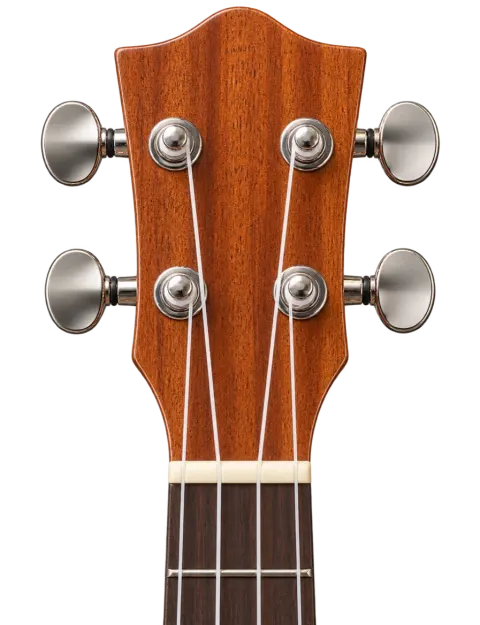
New strings stretch during their first few practice sessions, so frequent retuning is normal. Tune upward toward the target in small steps and avoid large peg movements. Once the strings have settled, the instrument should hold pitch for longer between checks.

02

Low-G Ukulele Notes and Frequencies

String positionTarget noteFrequencyFunction
4th, nearest your faceG3196.00 HzLow bass G
3rdC4261.63 HzLowest note in High-G tuning
2ndE4329.63 HzThird note in the GCEA sequence
1st, nearest the floorA4440.00 HzHighest open string

Low-G is often called linear tuning because the open strings rise from G3 to C4, E4 and A4. High-G is re-entrant: its G4 string is higher than C4 and E4. Both systems use the same chord shapes, but they do not produce the same range or arrangement possibilities.

03

What Makes Low-G Ukulele Tuning Different?

Low-G tuning replaces the traditional high G4 with G3. The lower fourth string extends the instrument downward by five semitones below C4 and puts the open strings in a continuous low-to-high order. Chord fingerings remain standard GCEA fingerings, so you do not need to relearn ordinary ukulele chords.

The most noticeable change is tone. A Low-G ukulele sounds fuller in the lower register and can provide a stronger bass note beneath chords. It is popular for fingerstyle arrangements, chord-melody playing and pieces that need notes below middle C. Scale patterns can also continue across the strings more naturally because the fourth string no longer jumps back into the upper register.

High-G remains a valid and distinctive choice. Its re-entrant tuning creates the bright, compact sound associated with traditional ukulele playing and makes many strumming patterns feel especially lively. Low-G is not universally better; choose it when you want a deeper voice and a wider melodic range.

Concert and tenor ukuleles are the most common candidates for Low-G strings. Some soprano instruments can also use Low-G, but string compatibility, nut-slot width and scale length should be checked. A thick or wound string that binds in the nut may tune unevenly and produce clicking, sudden pitch changes or poor intonation.

04

Tips for Accurate Low-G Tuning

  • Tune in a quiet room and move away from fans, televisions and conversations. Background sound makes it harder for the microphone to isolate the fundamental pitch.
  • Use guided mode when the instrument is far out of tune. Selecting G3, C4, E4 or A4 tells the tuner which string you intend to adjust and reduces confusion between nearby notes.
  • Pluck one string with a moderate, consistent motion. Very hard attacks create strong overtones and can briefly raise the detected pitch. Watch the reading after the initial attack settles.
  • Mute the other three strings. A ukulele body transfers vibration easily, so an open string may ring even when you did not play it directly.
  • Turn the tuning peg in small increments. If a note is far from its target, confirm the selected string and octave before adding substantial tension.
  • Check the tuning again after playing a few chords. New strings stretch, while small tension changes across the bridge and neck can move another string slightly out of tune.
  • For the final adjustment, approach the pitch from below. If a string is sharp, loosen it slightly past the target and then tighten it back into tune.
05

Low G Ukulele Tuner Troubleshooting

The tuner shows G4 instead of G3

Confirm that Low-G GCEA is selected and that the fourth string is made for Low-G tuning. G4 is the normal fourth-string pitch for High-G. The two notes share a letter name but are one octave apart.

The detected pitch keeps jumping

Mute the unused strings, reduce background noise and pluck more gently. Move closer to the microphone without placing the device against the instrument, and wait for one note to fade before playing the next.

The G string feels too loose

The string may be a standard high-G string rather than a dedicated Low-G string. Check its package or manufacturer guidance. A string intended for G4 will not normally perform well at G3.

The G string feels unusually tight

Stop tightening it and verify the selected octave. The target is G3 at about 196 Hz. Also confirm that the string is suitable for your ukulele’s scale length and that it moves freely through the nut slot.

The tuner cannot access the microphone

Open the browser’s site permissions, allow microphone access and reload the page. If a microphone is unavailable, use the G3, C4, E4 and A4 reference-tone buttons to tune by ear.

LOW-G QUESTIONS

Frequently Asked Questions

What is the correct tuning for a Low-G ukulele?

The correct open-string notes are G3, C4, E4 and A4, ordered from the string nearest your face to the string nearest the floor.

Can I use this low g ukulele tuner on a phone?

Yes. The tuner works in a modern mobile browser with microphone permission. No app, account or audio upload is required.

Can I tune a normal G string down to Low-G?

Usually not. A standard high-G string is designed for G4 and will normally be too loose at G3. Install a wound or unwound string specifically designed for Low-G tuning.

Do Low-G and High-G use the same chord shapes?

Yes. Both use the note names GCEA, so normal chord shapes remain the same. The difference is that the Low-G fourth string sounds one octave lower.

Is Low-G suitable for concert and tenor ukuleles?

Yes. Concert and tenor ukuleles commonly support Low-G string sets. Check the string maker’s scale-length guidance and make sure the fourth string moves freely through the nut slot.

How often should I tune a Low-G ukulele?

Tune before each practice or performance. New strings may need retuning several times during their first few playing sessions.